

Index
Topics
Share
A process built around the realities and needs of Guyana and Suriname seeks to strengthen the foundations for Integrated Water Resources Management (IWRM) in both countries. With support from the Amazon Basin Project, national experts and institutions participated in identifying gaps and priorities and in developing innovative instruments to improve water management, drawing on experiences from other Amazonian countries.
For each country, this process resulted in an Assessment of the Current IWRM Institutional and Legal Framework, development of a White Paper and an IWRM Toolkit. The products were developed by experts from Guyana and Suriname hired by the Amazon Basin Project, in close coordination with the respective Project National Coordination Units (NCUs).
More than a sequence of studies, the work combined technical analysis, consultations and participatory events with national stakeholders, as well as exchanges of knowledge and good practices among the Member Countries of the Amazon Cooperation Treaty Organization (ACTO). The objective was to support the development of solutions suited to the needs and institutional structures of each country.
Assessments identified challenges for more integrated management
The assessments of the institutional and legal frameworks were the starting point of the process. The studies analyzed existing structures and identified capacities, gaps, and opportunities to advance IWRM implementation.
In Guyana, the assessment showed that, despite the country’s abundant water resources and the existence of a significant legal framework being implemented by different institutions with water-related responsibilities, challenges remain in coordination, planning, information management and data sharing as provided for in the legal framework. The country also faces pressures associated with climate change, extreme events such as floods, droughts, storm surges and saltwater intrusion, as well as the impacts of its expanding economic activities and emerging industrialization on water quality and availability.
Among other needs, the study highlighted the reconvening and sustenance of the National Water Council (NWC) to support stronger coordination among institutions, the consolidation of a national IWRM policy, improved data-sharing mechanisms and the development of technical capacities.
In Suriname, the assessment identified a management structure distributed among different ministries and institutions, with a need for greater coordination, an updated legal framework, and stronger technical and institutional capacities. Water-related challenges include pollution, the impacts of small-scale gold mining, floods and droughts, saltwater intrusion, unequal access to drinking water, and insufficient protection of areas that are important for water security.
In both countries, the studies pointed to common challenges: insufficient coordination and communication among institutions, inadequate legislation and enforcement, limited knowledge, data, and existing capacities to effectively promote integrated and sustainable water resources management at the national level.
National participation and cooperation among Amazonian countries
The development of the products was accompanied by spaces for dialogue with institutions and other national stakeholders. In Guyana, for example, a National IWRM Workshop held in June 2024 brought together around 50 representatives of government institutions, non-governmental organizations, communities and Indigenous Peoples to discuss the assessment and formulate recommendations on the institutional, administrative, legal and financial reforms needed to strengthen IWRM.
The process also drew on the experience accumulated by other ACTO Member Countries. In 2023, representatives from Guyana and Suriname took part in a technical visit to Brazil’s National Water and Sanitation Agency (ANA) as part of an exchange of experiences on water resources management.
In July 2024, this cooperation continued with the participation of experts from Brazil, Colombia, Ecuador and Peru, who shared with Guyana and Suriname practices and knowledge related to water governance, information systems, data collection and exchange, participation, and capacity development being implemented in these Member Countries.
Cooperation took on a practical dimension through technical visits by representatives of Guyana to Peru and Colombia in November 2024. The delegation learned in more detail about institutions and water resources management models in both countries, seeking experiences that could contribute to strengthening water governance in Guyana.
In Peru, the representatives learned about the National Water Resources Information System and the National Water Resources Observatory of the National Water Authority (ANA), as well as experiences in participatory basin management that were of significant interest. In Colombia, the exchange covered the detailed institutional and legal framework for water management, planning and governance instruments, community participation, monitoring, and water resources information systems as led by the Ministry of Environment.
These exchanges broadened technical dialogue among the countries and provided exposure to different Amazonian experiences that could serve as references for developing solutions adapted to the realities of Guyana and Suriname.
White Papers set out roadmaps for institutional strengthening
Building on the gaps and priorities identified in the assessments and the contributions gathered throughout the stakeholder consultations and exchanges, the White Papers were developed to ensure concrete pathways for institutional strengthening for both countries.
In Guyana, the White Paper presents recommendations related to reviewing and updating water resources policy and legislation, strengthening coordination structures, expanding institutional capacities, and creating an integrated water resources database.
Among the recommendations was the reconvening of the National Water Council (NWC), alongside strengthening the role of the Hydrometeorological Service, improving coordination among institutions, and developing mechanisms to compile and share standardized information to support decision-making. The NWC was reconvened in August 2024 and met again in July 2025, representing a concrete step toward implementing this recommendation and strengthening national coordination for water resources management.
In Suriname, the White Paper proposes a progressive transformation of water governance, with stronger national coordination, modernization of the legal framework, improved information and monitoring systems, capacity development, and the creation of sustainable financing mechanisms.
Additionally, it was recommended for the strengthening of the existing Water Platform, providing it with institutional and legal backing to perform IWRM coordination functions. The document also emphasizes the participation of different sectors of society, including academia, the private sector, civil society organizations, women, Indigenous Peoples and tribal communities.
Tools to support implementation
While the assessments identify the main challenges and the White Papers set out pathways to address them, the IWRM Toolkits bring together tools, methods and references that can support implementation of the recommendations.
The regional cooperation developed throughout the process is also reflected in these instruments, which incorporate water resources management experiences and good practices from other Amazon Basin countries as references for Guyana and Suriname.
In Guyana, the IWRM Toolkit covers topics such as policy and legislative development, financing mechanisms, institutional coordination, information systems, monitoring, modeling, river basin management and capacity development.
It also identifies specific professional training needs in areas such as hydrology, hydrogeology, surface water and groundwater monitoring, water quality analysis, modeling, geographic information systems, data management and policy development.
In Suriname, the IWRM Toolkit proposes instruments to structure governance at different levels, strengthen river basin management and expand local participation. Proposals include a national water authority, basin councils and community committees, as well as an integrated legal framework and a national water resources information system.
The document also incorporates economic instruments and participation mechanisms, including provisions focused on Indigenous and Maroon communities and gender inclusion.
In this way, these IWRM ToolKits translate part of the strategic recommendations into references and instruments that can support the institutions and professionals responsible for advancing IWRM in both countries. Suriname’s IWRM ToolKit is also available online, providing direct access to the tools and resources developed through the process.
From developing instruments to strengthening people
Human capacity development is a recurring element in the assessments and instruments produced. In Guyana, this work gained new momentum with the signing of a Letter of Intent between ACTO and the University of Guyana, establishing a cooperation framework focused on water governance.
The Letter was signed by ACTO Secretary General Martín von Hildebrand and the Vice-Chancellor and Principal of the University of Guyana, Paloma Mohamed Martin. The cooperation involves the School of Graduate Studies and Research, the Faculty of Earth and Environmental Sciences, and the Faculty of Agriculture and Forestry.
The areas envisaged include academic and scientific exchange, seminars and joint activities on water resources management and financing mechanisms, as well as capacity development for professionals working in the water sector, particularly in hydrometric monitoring, data management and water resources information systems.
The partnership also aims to ensure the training of 50 water-sector professionals, continuing the effort to turn the needs identified throughout the process into lasting technical capacities in the country.
A similar capacity-development initiative is envisaged for Suriname, with the training of 50 water-sector professionals. The initiative is expected to be formalized through a Letter of Intent with Anton de Kom University of Suriname, which has yet to be signed.
Institutional strengthening, from the national level to regional cooperation
The set of actions developed in Guyana and Suriname forms part of Component 1 of the Amazon Basin Project, which focuses on institutional strengthening at the national and regional levels for efficient and effective water governance. The aim is to contribute to more integrated management, from communities to government institutions, with benefits for basin management, ecosystem conservation and people’s livelihoods.
In this context, the work carried out in both countries combines national knowledge, stakeholder participation, regional cooperation and capacity development. By bringing together national experts and NCUs with public institutions, universities, communities and other stakeholders, and connecting this process with the experiences of other Member Countries, the Amazon Basin Project helps Guyana and Suriname define pathways suited to their realities for strengthening water governance.
The Assessments, White Papers and IWRM Toolkits thus form a complementary set: as they identify gaps, establish priorities and provide instruments to support IWRM implementation. Technical cooperation among countries and training activities add another essential component: strengthening the people and institutions responsible for turning these instruments into concrete and sustainable action.
This process contributes to implementation of the Strategic Action Program (SAP) for the Amazon Basin, strengthening national capacities while simultaneously expanding regional cooperation for the integrated management of the region’s shared water resources.
Related news
2 de September de 2026
The Amazon Cooperation Treaty Organization (ACTO), within the framework of the Amazon Basin Project (ACTO/UNEP/GEF), has opened a selection process [...]
31 de August de 2026
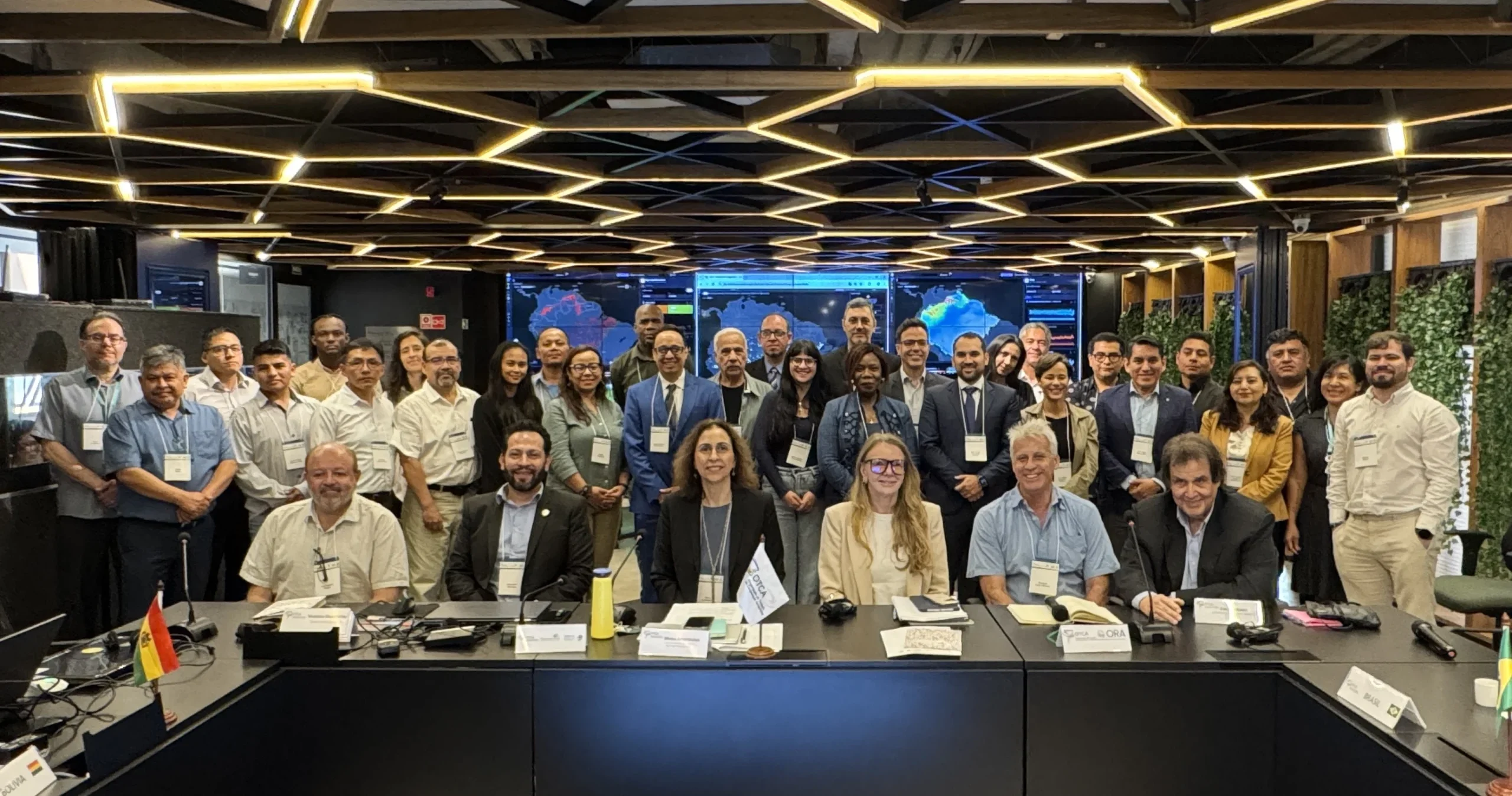
The Member Countries of the Amazon Cooperation Treaty Organization (ACTO) are advancing the interoperability of their hydrometric and water quality [...]
14 de August de 2026
The Amazon Basin Project (ACTO/UNEP/GEF), in partnership with Colombia’s Ministry of Environment and Sustainable Development and with technical support from [...]
